Insights · Aviation
Summer flight chaos 2026: why it's worse this year and what passengers need to know right now
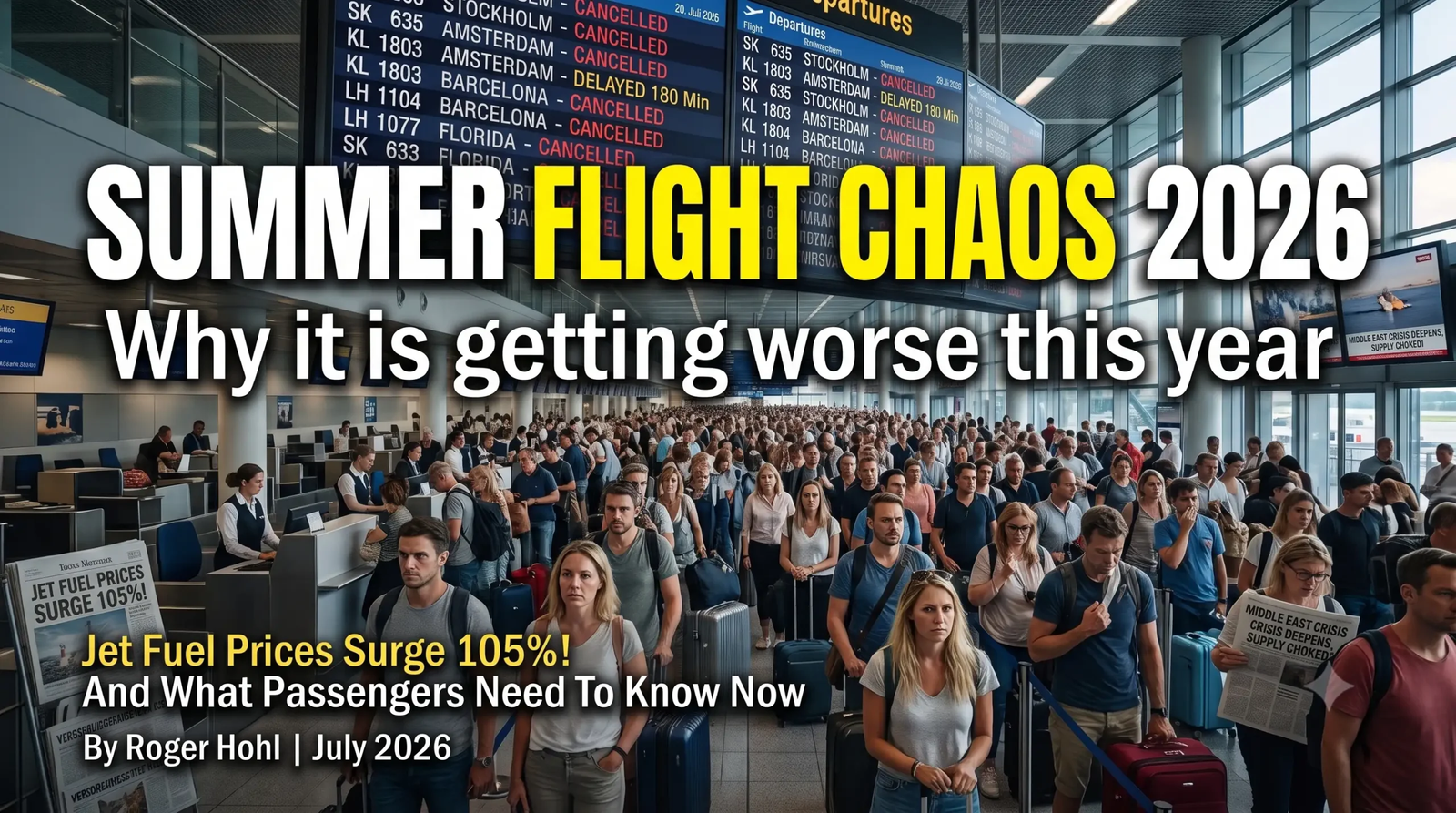
Anyone flying this summer needs steady nerves. That is not a new observation: summer flight disruption has been part of travel life for years. But 2026 is different. Not just more passengers, not just too few staff, not just overloaded airports. This time the chaos is driven by a structural shock unlike anything I have seen in more than twenty years in aviation.
Jet fuel prices in Europe have risen 105.7 percent compared to last year. The war in Iran has severely disrupted supply routes through the Strait of Hormuz. Jet fuel stockpiles in the Amsterdam-Rotterdam-Antwerp corridor, the most important fuel hub for European airlines, fell earlier this year to their lowest level since April 2020. The International Energy Agency warned that Europe could face serious shortages within weeks.
The result: airlines are cutting flights, raising prices, and fighting to stay viable. And passengers are caught in the middle.
Why summer chaos happens every year and why 2026 has escalated
The summer disruption has structural causes that have nothing to do with jet fuel prices. They exist every year:
Overbooked capacity. Airlines plan their summer schedules months in advance, and they tend to cut things fine. Every delayed flight creates a cascade through the entire day’s operation. An aircraft arriving late into Frankfurt in the morning flies back late from Mallorca in the evening. This domino-effect problem is structurally unavoidable. It can only be cushioned by larger operational buffers. Buffers cost money. Most airlines consider them too expensive.
Staff shortages in critical roles. Ground crews, air traffic controllers, security staff: these roles are hard to fill and almost impossible to scale quickly. In summer, when volume explodes, staffing at many airports simply falls short. In 2022 this was a disaster; in 2023 and 2024 it was better, but not solved.
Thunderstorms and bottleneck sectors. European airspace is at capacity in summer. France’s upper airspace has been chronically congested for years, and every storm over the Alps triggers chain reactions that take hours to unwind.
All of this is well understood. What is new in 2026 is that airlines already weakened by the fuel shock can afford even less buffer than usual. An operation running at its limit tips over faster.
Who is worst affected this year
The numbers speak clearly.
Scandinavian Airlines has already cancelled more than 1,000 flights. easyJet reported pre-tax losses exceeding £540 million for the first half of 2026, directly attributing the figure to surging fuel costs. KLM cut 160 flights to and from Schiphol in May alone, and Turkish Airlines temporarily suspended 18 routes. Ryanair has warned it may cut up to 10 percent of its summer schedule if supply conditions tighten further.
Even the most stable carriers are not immune. Lufthansa expects approximately €1.7 billion in additional costs from the fuel price spike, despite running one of the most robust hedging strategies in the industry. The group’s hedge position covers around 80 percent of its 2026 fuel requirements. That provides meaningful insulation, but it only goes so far when prices have more than doubled.
What this means in practice: flights that appear in booking systems today can be cancelled at short notice. Routes that no longer make financial sense disappear quietly from the schedule. And those who booked the cheapest fares feel it first.
What the industry must do now and where it is getting things wrong
The crisis is mercilessly exposing which airlines have done their homework and which have not.
Ryanair has hedged approximately 80 percent of its 2026 fuel requirements. That gives the group significant insulation against spot market prices and explains why CEO Michael O’Leary has remained comparatively calm. Lufthansa runs a similarly disciplined hedging strategy. These carriers bought expensive insurance instruments during calmer times, precisely for situations like this.
Those who did not are now exposed. easyJet’s £540 million first-half losses are not bad luck. They are the result of an inadequate risk strategy in an environment that should have priced in geopolitical volatility. Fuel has accounted for close to 30 percent of airline operating costs for years. That is not a number any serious risk manager should be surprised by.
The second structural problem is route optimisation under pressure. An airline cutting flights now needs to do so surgically: reduce thin-margin leisure routes while preserving the higher-yield connections that sustain profitability. The art lies in protecting business travel demand while shedding the routes that never made financial sense at elevated fuel costs. SAS reacted aggressively with more than 1,000 cancellations. Whether that was strategic or purely operational remains to be seen.
And then there is the capacity constraint that cannot be resolved quickly: Airbus and Boeing continue to deliver with massive delays. Airlines cannot refresh their fleets at the speed they want. Older, fuel-hungry aircraft stay in service longer, precisely when every litre counts.
What this summer means for the industry long-term
I will say it plainly: the airlines that navigate this summer well will emerge stronger from the crisis. Not because it was easy, but because they prove they can operate under genuine pressure.
What will shift afterwards: consolidation continues. Carriers that reveal structural weaknesses this summer (insufficient capital, no hedging strategy, no clear route priorities) will become acquisition targets or disappear. That is not speculation; it is the logic of a market carrying too many airlines for too little margin.
What remains: jet fuel will be more expensive and more volatile over the long term. The Middle East is no longer a short-term disruption. It is a permanent risk factor. Airlines that have not yet built this into their strategy will have to do so. Or they will pay the same price again at the next shock.
Conclusion: not a summer for weak balance sheets
The summer flight chaos of 2026 is not a run of bad luck. It is the outcome of a structurally strained industry simultaneously managing a historic fuel shock, ongoing delivery constraints, and an overheated booking environment.
My assessment as an aviation expert: the situation is more likely to worsen through August than to ease. Airlines that make the right decisions now (route optimisation, hedging discipline, operational stability) will emerge from the summer in stronger shape. Those that rely on hope instead of strategy will face the consequences in autumn.
Would you like to engage Roger Hohl for a media interview on the current situation in aviation? Get in touch now.