Insights · Aviation
Why airlines keep running into crisis and what executives can learn from it
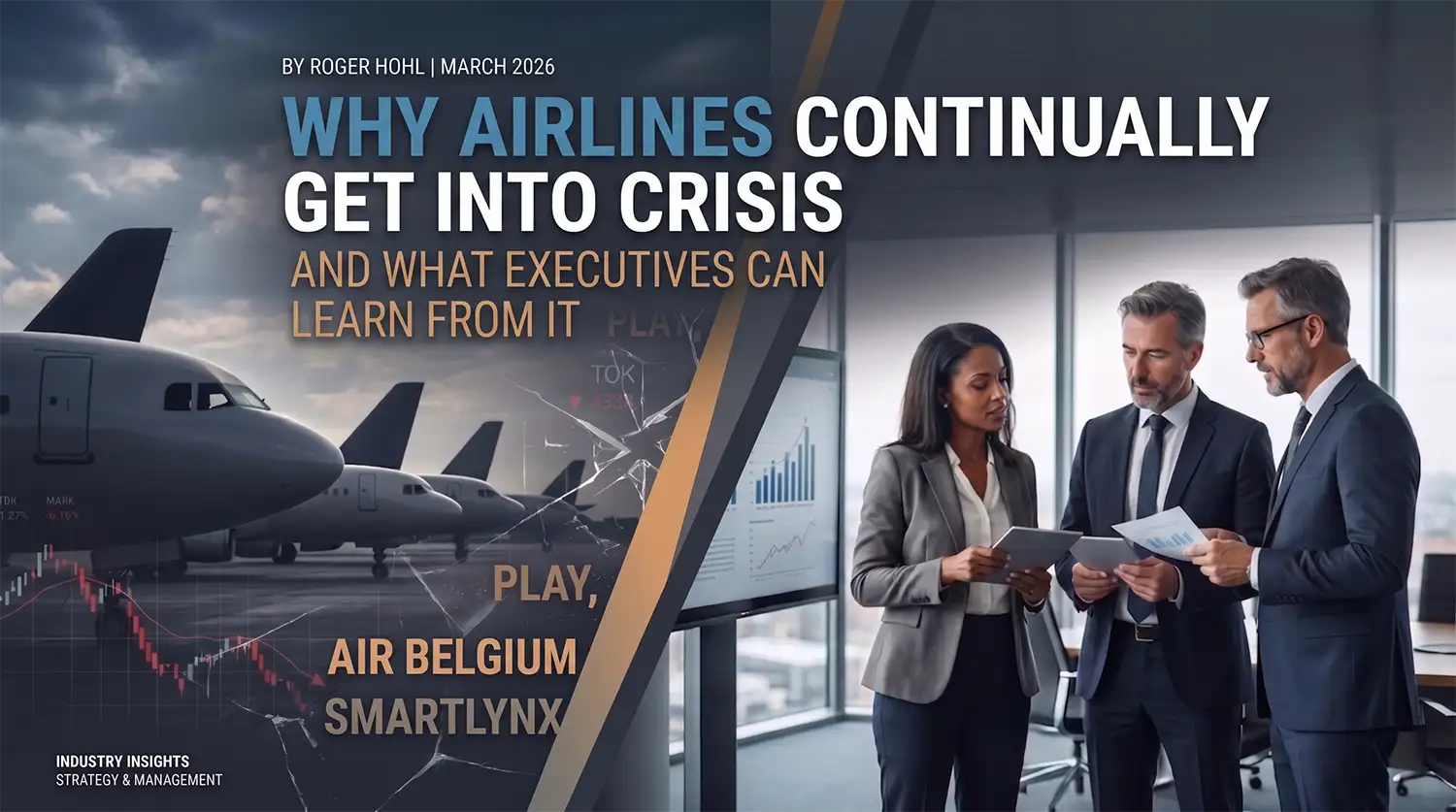
Play is gone. Air Belgium is gone. Smartlynx spent much of last year fighting for survival under 238 million euros in liabilities. And those are just the names that made the headlines.
Aviation is an industry that regularly consumes its own. I say that not as criticism but as someone who has worked as the CEO of an airline and knows how razor-thin the line between success and insolvency is in this business. What strikes me, again and again, is that the patterns are always the same. And yet almost nobody draws the right conclusions.
In this article I want to explore why airlines so often end up in crisis and what executives, board members, and investors can take away from it. Not just for aviation, but for any organisation operating under extreme cost pressure and high volatility.
The core problem: a business model with no margin for error
Airlines are among the most capital-intensive and lowest-margin businesses in the world. In good years, profit margins sit at two to four percent. Every percentage point rise in fuel costs can rip millions from the balance sheet. Every geopolitical shock (a war, a pandemic, an airspace closure) hits the industry immediately and with full force.
The model has no structural margin for error. Running an airline as CEO means leading a business that hits its limits the moment anything unexpected happens. That is not a management failure. It is the reality of the industry.
But some airlines survive. And some do not. The difference usually lies not in the business model, but in the quality of leadership.
Mistake 1: Growth as an end in itself
Play was founded in 2021 as the successor to the failed WOW Air, using the same model that had driven WOW Air into insolvency: cheap transatlantic flights with a stopover in Iceland. When the numbers deteriorated, Play cut transatlantic routes and tried to pivot to intra-European flying. Too late, too half-hearted, and without sufficient capital reserves.
I recognise this pattern from personal experience. Airlines grow too fast, open too many routes simultaneously, tie up capital in fleet expansion, and then find themselves without a liquidity buffer at the first sign of market weakness. Growth is not an end in itself. An airline profitably operating ten aircraft is worth more than one losing money with thirty.
What strong leadership does differently: Disciplined growth. Every new route, every additional aircraft must have a clear business case, and the worst-case scenario must be modelled before any contracts are signed.
Mistake 2: Crisis plans exist only on paper
In my time as CEO I learned this early: an airline without a detailed crisis plan is not an airline. It is a bet. And yet time and again I encounter organisations where crisis scenarios appear in strategy documents but are never genuinely rehearsed.
What happens if fuel prices rise 30 percent? What happens if an airspace is closed overnight? What happens if a key supplier fails? These questions must not wait to be answered in the heat of a crisis. They need to be worked through, simulated, and embedded in the organisation’s operational memory during calm periods.
Lufthansa offers an instructive counterexample. Despite considerable cost pressure and an ongoing turnaround programme, the group has built a crisis resilience that smaller carriers simply do not have. Not because Lufthansa is inherently better, but because scale and structure allow for buffers that small carriers cannot maintain.
What strong leadership does differently: Simulate crisis scenarios regularly. Not as theoretical exercises, but as operational preparation. And protect a liquidity buffer even when investors are pushing for short-term returns.
Mistake 3: Stakeholders are brought in too late
In the Smartlynx case, creditors, including Lufthansa Technik and Airbus, were only properly engaged once insolvency proceedings began. This is a classic pattern: management fights the crisis internally, projects stability externally, and by the time the truth emerges, trust has been irreparably destroyed.
I have experienced first-hand what it means to bring stakeholders into difficult situations early. It is uncomfortable. It requires the courage to acknowledge problems before they escalate. But banks, investors, and business partners who are informed early are far more willing to support solutions than those who first learn the scale of the crisis from a press release.
What strong leadership does differently: Transparency as strategy. Not as weakness, but as strength. Those who communicate early retain the initiative. Those who wait too long lose it.
Mistake 4: The CEO cult
Airlines are often led by strong personalities. That can be an advantage: decisiveness, vision, drive. But it becomes the greatest liability when the CEO cult means warning signals from the team are ignored.
Throughout my career I have watched experienced managers in boardrooms and executive teams identify problems but stay silent, because the organisational culture did not tolerate dissent. This is one of the most dangerous dynamics in any organisation, but particularly in aviation, where the consequences of poor decisions are immediate and severe.
What strong leadership does differently: Build a culture where bad news travels fast and upward. Never punish the person who raises a problem. Recognise them. And as a CEO, hold your own opinion back until everyone else in the room has shared theirs.
What board members and investors can take away
The lessons from these patterns extend well beyond aviation. They apply to any business operating under pressure:
First: growth plans without worst-case scenarios are not plans; they are wishes. Second: crisis resilience is not insurance against bad times; it is a competitive advantage in good ones. Third: transparency with stakeholders is not a risk; it is the foundation of trust. And fourth: the best investment in crisis prevention is an organisational culture that surfaces problems before they escalate.
As a former airline CEO and current advisory board member and consultant, I help organisations build exactly these structures. Not as a theoretical concept, but from lived experience.
Would you like to learn more or engage Roger Hohl for an advisory board mandate or a consulting assignment? Get in touch now.